| a chromatic noise generator in vhdl | |||
|
DNG LFSR |
Configurable Noise Generator with predictable results The following logic represents a 20-bit LFSR that uses the known polynomial (x^20 + x^3 + 1). See the former page for details of its function: LFSR Noise Generator The resulting frequency difference here is already less than 0.1 Hz and is therefore completely inaudible to the human ear. The result is a perfectly uniform, analog hissing sound (white noise) with no perceptible pitch. Only by reducing the number of registers individual frequencies become more evident. To make sure the noise is mostly flat to be used in music apps, an overlay of noise for the relevant frequencies is done. 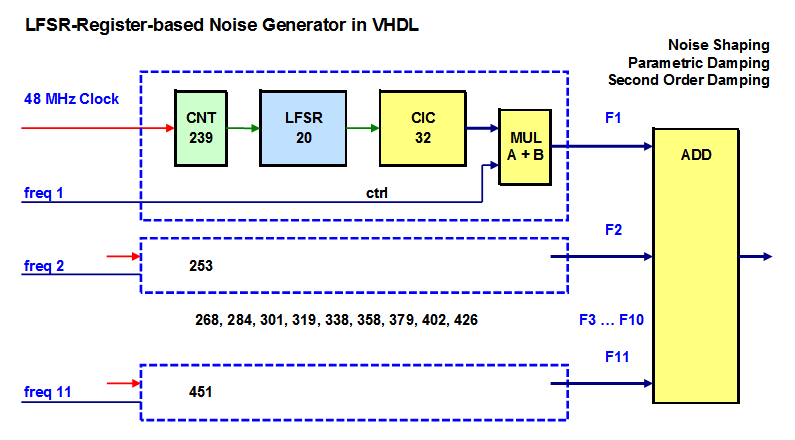
A TOS-design is used to generate the relevant frequencies as known for organ tones. A frequency of 48 MHz is used—24 times the standard frequency. This produces 11 frequencies, each of which drives an LFSR. The addition of these 11 independent LFSR units results in a very dense, multichromatic line spectrum through superposition, in which the power density spectra of the individual sources add linearly, since the signals are completely uncorrelated due to their different local clock rates. Since the units form their own comb structure, the countless spectral lines practically never overlap mathematically. Depending on the demands the signal is filtered by a CIC and post processed by a FIR in order to limit the harmonics down to e.g supersonic or audible range. The amplitude control values allow to adapt the spectral response.  See details of the function: LFSR noise generator SRead about another NG: Noise Generator |
||
|
Digital Processing |
|||
|
48 kHz Audio DSP |
|||
|
|
|||
© Sound of L.A. Music Productions 2006