| A Music Synthesiser with FPGA | |||
|
PLD SYNTH 48kHz x 16 Bit |
FPGA-Platform Xilnx Spartan 3E A modern Spartan 3E platform is used to implement a design for my PLD-Synthesiser. 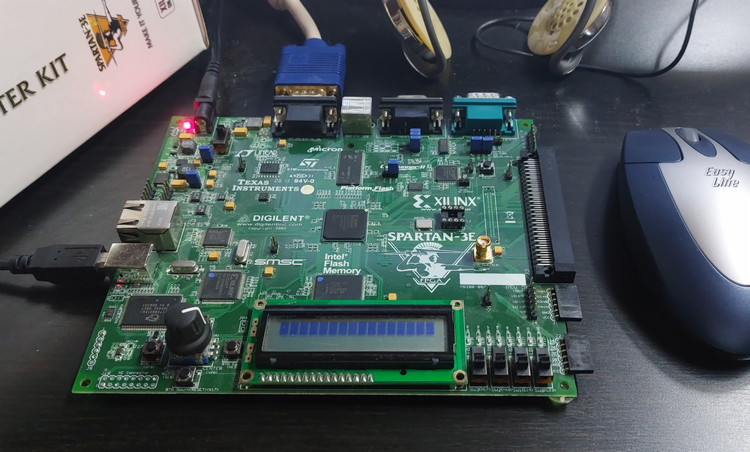 The circuit is a complete VHDL-implementation of my music synthesizer wich formerly was built for Xilinx XC4000 PLDs and following. Because of the greater resources, some additional functions could be integrated, which already had been used in the C-Version on my chameleon synthesiser. Circuit Function The design uses the DDS method with a given tuning word. This is derived from a frequency information of the MIDI word and progresses a phase counter. Together with the vibrato information, this generates a phase value for to the waveform generators. 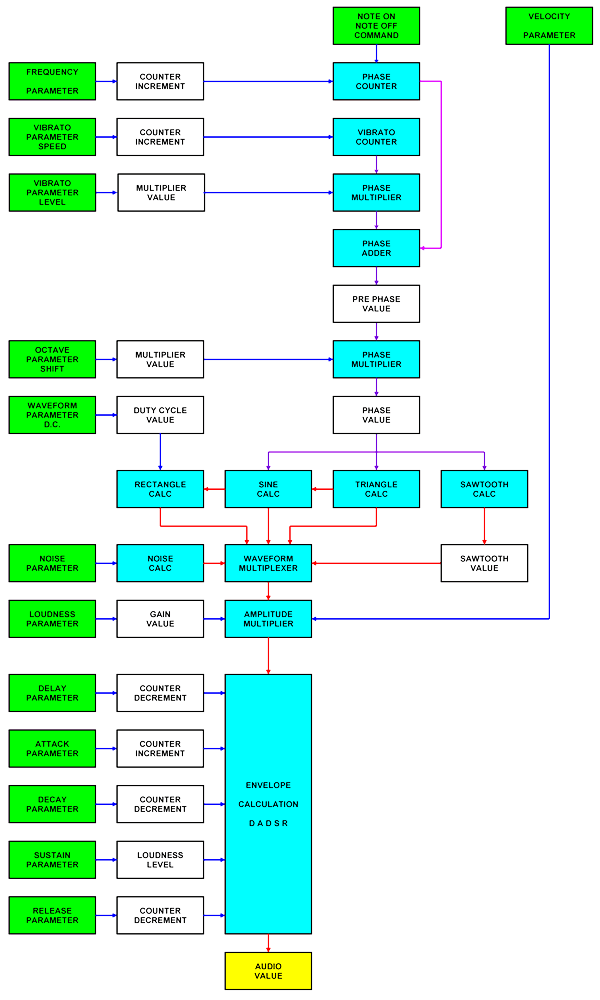 The phase counter is directly used as a sawtooth. The triangle is generated by flipping the bits partially when the phase counter is greater than 50%. The sine wave can be done in two ways by diode clipping or super imposing waves: As in the first version the third harmonic is subtracted from the actual triangle. The phase of that harmonic is generated by shift-and-add processing like 3 * phase = 2* phase + phase, so no multiplicatin is required. Additionally a 5th harmonic is introduced. The final sine wave than is sin (f) = tria(f) + a * tria (3f) + b * tria (5f). I found 1/8 and 1/24 for a and b. This produces almoset a good sine-like tone.  The quality could be furtherly increased if the chip had more resources to implement more waves. With forthcoming FPGAs more waves shall be possible. However unlike in the PLD version we have more options for math processing so diode clipping as inthe famous 8038 can be applied:  Due to limited space, modulation via the parameters and the ADSR is also still coarse in comparison to analog synthesisers. Read about the former circuit PLD-Synthesiser |
||
|
48 kHz Audio Synthesis |
|||
|
|
|||
© Sound of L.A. Music Productions 2005