96 kHz.org
Advanced Audio Recording

Structure of todays Techno Devices

People often wonder why an excessively high sampling rate—beyond the audible range—is needed to emulate virtual analog synthesizers. The reason can be found in the electrical design of the generator circuits in such devices:

The internal audio signal is not limited to the audible range of 20 Hz–20 kHz. The TB-303 and similar techno synthesizers frequently use converter circuits that generate very steep-edged signals from previously band-limited signals, e.g. clean sine waves. These alone already produce inaudible harmonics. The special VCOs contained within ultimately produce waveforms rich in harmonics, whose electrical signal components extend far beyond 20 kHz. Sawtooth and rectangle wave signals from comparators or integrators contain components extending into the MHz range.

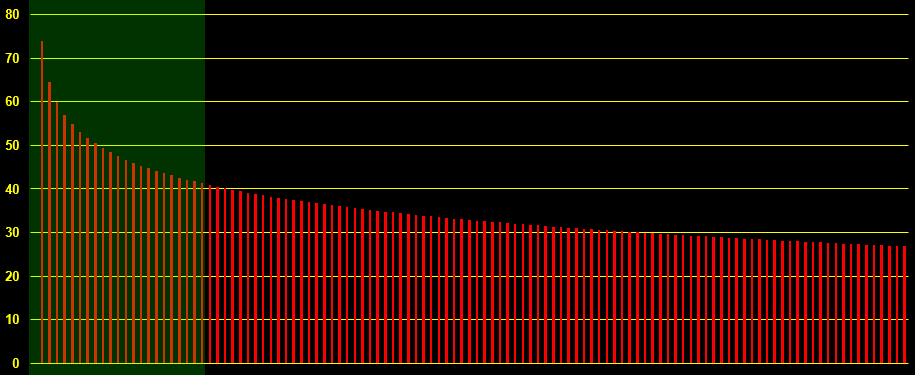
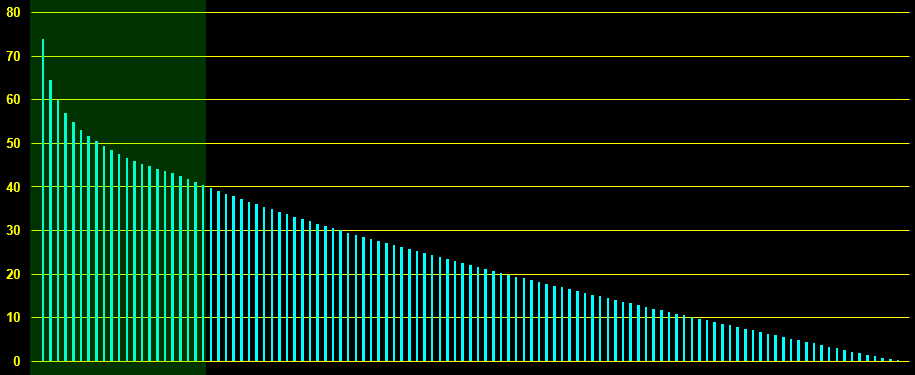
The subsequent image shows the mathematical harmonics of a rectangle wave up to 100kHz with their levels in decibels:

mathematical harmonics of the rectangular wave

The green are shows the audible range below 20kHz. The base frequency has 440Hz and a level of normalised 74dB. 3/4 of the harmonics at all and 2/3 of the harmonics shown range beyond 20kHz summarizing to a total of 86dB, the classical mix level in the studio. Assuming 20dB as the relative threashold for listening, all the mathematical frequencies were audibile when transported out.


Real Waves and effects in Synthesizers

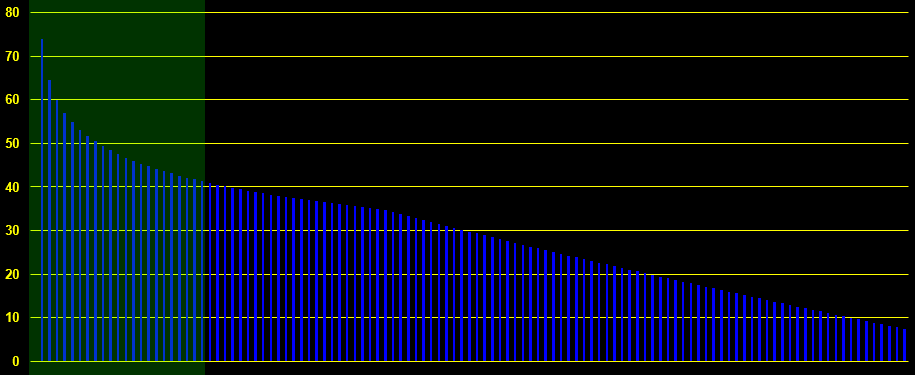
In the TB-303, the VCO initially generates a sawtooth wave directly. Its harmonics are integer multiples of the fundamental frequency and decrease approximately by a factor of 1/n. The subsequent wave shaper further shapes this wave. The same applies to the rectangle. The steep edges result in new, additional high-frequency harmonics, which do not all musically align with the fundamental frequency but are built up based on the Fourier series. The bandwidths of the electrical components and their circuitry are decisive here. Depending on the actual rise time, frequency components in the 100-kHz to potentially MHz range can occur. Also the wiring also plays a role. Measurements show that relevant components are detectable well beyond 200 kHz!


harmonics of the rectangular wave in analog synthesizers

As for an example a harmonic spectrum with a moderate low pass filter starting already at 40kHz is presented here. The levels of the higher harmonics disappear in the inaudible level range of less than 20dB for frequencies beyond 80kHz. Although the subsequent VCF (transistor ladder filter) removes many of these high-frequency components, it is itself nonlinear due to its design. Therefore, in addition to the desired filtering effect, it also generates new, unwanted frequency components.

This is even more then case because nonlinear distortion circuits are also used later on, which have the ability of generating new, non-musical harmonics. So in typical analog synthesizers, on the one hand, the characteristics of the electronics cause high frequencies to be attenuated as the frequency increases; on the other hand, new frequencies are generated.

Audible Waves of Synthesizers

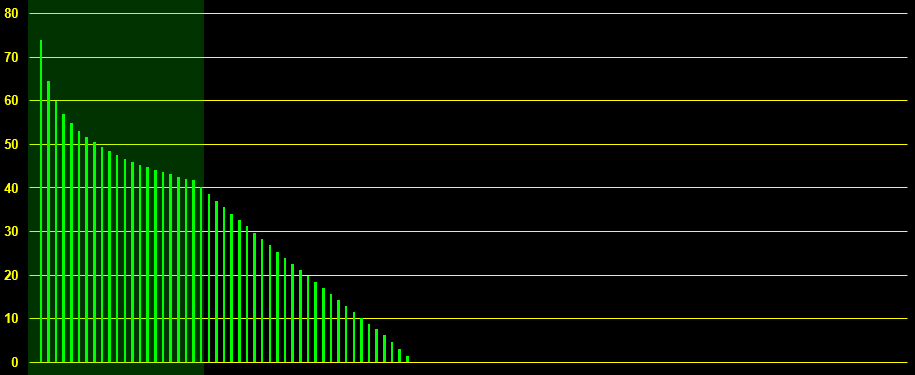
Depending on the wave treatment and output bandwidth limitation several of these harmonics show up at the output. Typically a strong filter limits the bandwidth of such synthesisers to 16kHz or 20kHz so one hardly can measure anything in the higher range. However in the example frequencies up to 40kHz show up.

band limiting in analog synthesizers


As said the limit at the output says nothing about internal effects at all, as we will see now:

Combined Waves

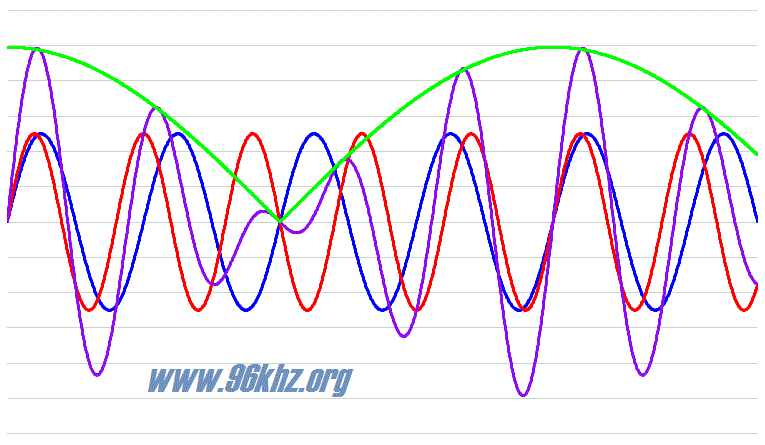
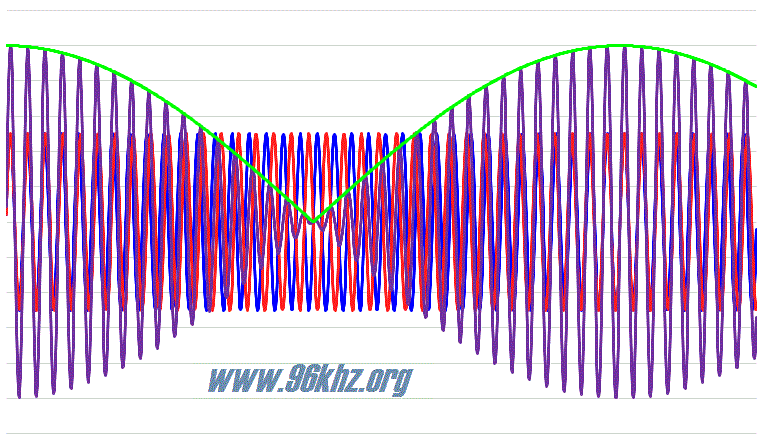
Sine waves of different frequencies can produce a series of different sums and differences, such as f1+f2, f1−f2, 2f1−f2, and so on, when operating together. This refers to simple addition as well as complex ring modulation which in fact is a multiplication of two waves. For instance two sine waves of 220Hz and 275Hz do interact this way with each other when added:

envelope when adding two waves

The result is a mixture of 247.5 Hz with a 55 Hz envelope. When high-frequency components eventually pass through a filter, only this low-frequency component remains if the filter is set appropriately. Let’s consider, for example, the 11th harmonic of 220 Hz and the 9th harmonic of 375 Hz: We again observe an envelope of exactly 55 Hz at mixed frequencies in the inaudible range.


frequency mixing - two waves 11th and 9th harmonic


Mathematically speaking, these two frequencies behave as if they had been multiplied, even though they were simply added together. The same is true in reverse when ring modulation is used. Two frequencies emerge . Furthermore, this applies to all harmonics in the signal, which becomes interesting when using different waveforms. When multiple keys on the keyboard are played, this results in a multitude of harmonics and their intermodulation products.


Intermodulation due to Nonlinearity

The key components in analog synthesizers are the nonlinear elements located before or after filters, such as in the well-known Moog filter. Its distinctive sound arises from its nonlinear behavior, which roughly follows a hyperbolic tangent curve and leads to saturation at higher signal levels. On the other hand, the electronics aren’t fast enough to track rapid transients, resulting in a smoothing effect. Many other synths, such as the 303, also incorporate such features. Such nonlinearities can generally cause frequencies to blend together, resulting in relatively low-frequency components that were not previously present in the mix. Thus, high-frequency energy can indeed be converted back into lower frequencies.

As for another practical example, consider two tones a third apart at 220 Hz and 261.6 Hz: This can produce frequencies of 178.4, 303.5, 136.7 and 344.9, as well as the resulting difference frequencies of 95.1, 87.4, 73.8, and even more significantly lower-frequency components of higher order.

With sawtooth waves, the effect becomes even more complex because numerous harmonics are already present. The nonlinearity can therefore also mix, for example, 440 Hz and 523.25 Hz with each other. All of these effects must be properly handled in order to fully replicate the function of an analog synthesizer at all.


Nyuists Theory

Since the resulting harmonic and non-harmonic mixed products are part of the analog synthesizer’s sound, they must logically be accurately represented in order to replicate it. It is crucial that the high harmonics—to the extent they are present in the real electrical signal—be carried over into the virtual mathematical signal if they are to be processed. In doing so, the Nyquist-Shannon theorem must always be observed; that is, the sampling frequency must be at least twice the highest frequency to be represented.

The key factor for the sound is which frequencies are strongly present in the signal. A component at, say, 50 Hz (Intermodulation + Filtering) or 150kHz (harmonic) may theoretically exist, but it is inaudible if it is too weak. To make an accurate assessment, the FFT spectrum must therefore be examined more closely. An analysis of measurements of analog synthesizers and their internal bandwidths thus reveals a need for frequencies up to 300 kHz, but at least 150 kHz. This results in the requirement for a sampling frequency of 384 kHz–768 kHz.

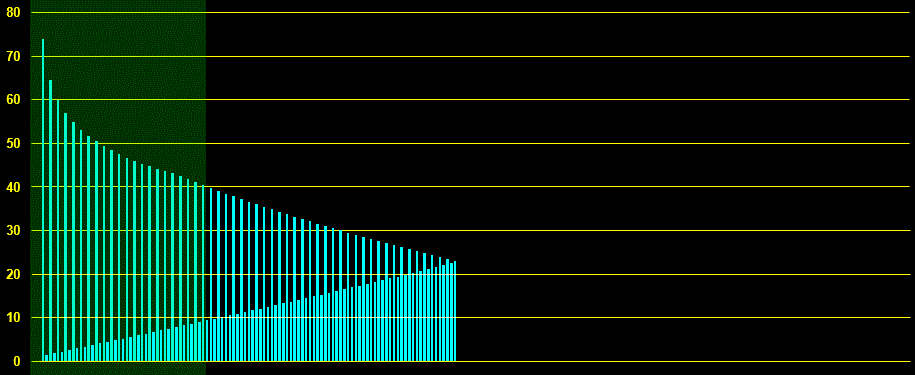
To lower the demands one can limit the harmonics stronger than it is in reality. The subsequent image shows the rectangle from above with a low pass starting already at 16kHz which limits the spectrum to around 50 ... 70kHz regarding the audible range limit.

band limiting in analog synthesizers


Doing so, a 192kHz sample frequency would be ok to represent the behaviour most correctly while a 96kHz would have strong mirror frequencies:

mirror frequencies of a rectangle at 96kHz
 

However, higher sample frequencies lower the issue of finding trade off between true sound and processibily.

Also regarding the issue of appropriate reconstruction filters oversampling helps to deal with all frequencies in the audio spectrum. If one has a look at extreme sound synthesis cases, higher frequencies might occur which will cause unwanted effects leading to the conclusion that 768kHz should be chosen in some cases. This is interesting since for sound synthesis 192kHz is the currently preferred frequency and 384 kHz is currently the highest discussed frequency for audio signal representation in Software-DAWs.

Summary and Conclusion:

The interesting finding is that analog, nonlinear circuits such as the TB-303 do not merely filter out high frequencies, but can mix existing harmonics with others, thereby generating new, significantly lower frequencies. This essentially leads to issues when emulating analog behaviour: Whether effect is sonically relevant in a particular device depends on the actual levels, nonlinearities, and bandwidths of the circuit. Generally sampling frequency has to respect this demand.

 
Read more about 192Hz recording and the comparison 48/96/192kHz


© 2006 J.S.